Marketing Mix Modeling System
Challenge
Companies across industries struggle to understand which marketing channels truly drive business growth, often making budget allocation decisions based on incomplete attribution data. Traditional methods fail to capture cross-channel effects and diminishing returns, leading to systematic under-investment in high-performing channels while continuing to fund ineffective campaigns that drain marketing ROI.
Solution
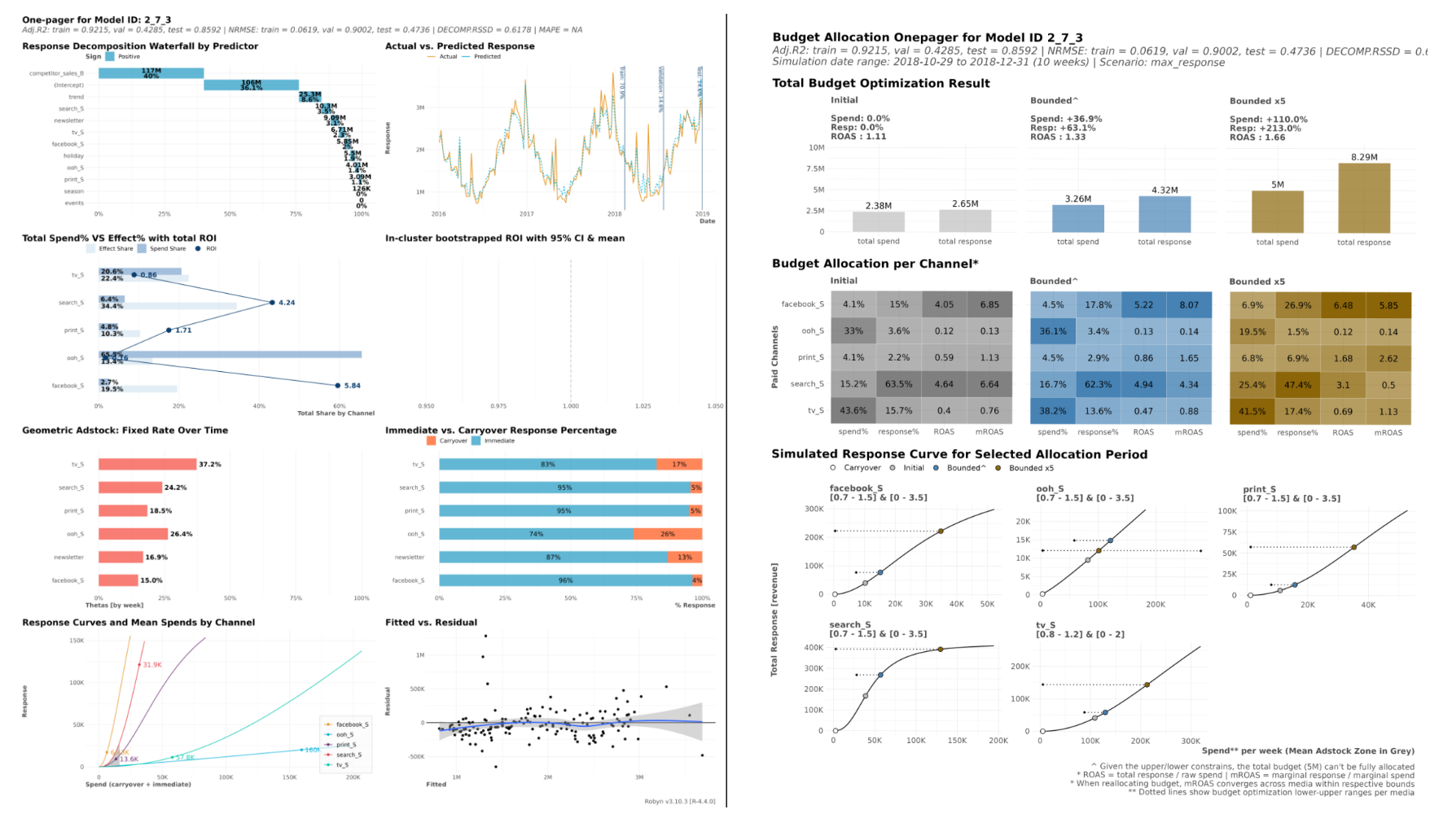
Advanced marketing mix modeling using Meta’s Robyn open-source framework to decode true channel attribution and optimize budget distribution across all marketing touchpoints. Through comprehensive statistical analysis and media saturation curves, the solution quantifies incremental contribution of each channel and provides actionable recommendations for maximum marketing effectiveness across e-commerce and pharmaceutical industries.
ROI
Example Scenario: E-commerce retailer with $2M annual marketing spend generating $20M revenue
Current Pain Points:
- Misallocates $500K annually due to poor understanding of channel performance
- Loses $1M in potential revenue by under-funding high-ROI channels
- Continues investing $300K in saturated channels with diminishing returns
- Lacks visibility into optimal budget distribution across seasonal cycles
After Implementing Marketing Mix Optimization:
- Strategic reallocation: Shift 25% of budget to highest-performing channels → Gain $750K revenue (38% ROI improvement)
- Eliminate saturation waste: Reduce spend on diminishing-return channels by 40% → Save $250K (12.5% cost reduction)
- Cross-channel optimization: Leverage channel synergies and interactions → Gain $300K additional revenue (15% efficiency boost)
- Seasonal planning: Optimize budget timing across peak periods → Improve overall marketing efficiency by 20%
Total Annual Impact: $1.3M in increased revenue and cost savings (65% improvement in marketing ROI)
Marketing Efficiency Gains: ROAS improvement from 10:1 to 16.5:1 ratio
Framework applies across industries: pharmaceutical companies typically see 45-70% ROI improvements in professional marketing, DTC campaigns, and conference investments.
Benefits
- True Incremental Impact: Sophisticated statistical modeling separates correlation from causation, revealing which channels actually drive incremental business growth versus those riding on organic trends.
- Cross-Industry Expertise: Proven methodology works equally well for e-commerce customer acquisition and pharmaceutical professional engagement, adapting to different sales cycles and attribution windows.
- Media Saturation Analysis: Advanced curve modeling identifies optimal spend levels for each channel, preventing waste on over-saturated channels while uncovering scaling opportunities.
- Budget Optimization: Data-driven reallocation strategies maximize return on marketing investment by directing spend toward channels with highest incremental contribution potential.
- Strategic Planning: Long-term modeling enables informed budget planning across quarters and seasons, accounting for external factors and competitive dynamics.
- Channel Synergies: Reveals hidden interactions between marketing channels, enabling coordinated campaigns that amplify overall effectiveness beyond individual channel performance.
- Measurable Results: Quantifiable improvements in marketing efficiency provide clear ROI justification and build confidence in data-driven marketing decisions.