A system we built. The figures below are modelled at a representative scale rather than the client’s actual numbers, which are confidential — so you can substitute your own. How we build these numbers →
Challenge
Businesses across industries struggle with outdated forecasting methods that fail to capture complex market dynamics, seasonal variations, and sudden demand shifts. Traditional linear regression and basic time series models break down during volatile periods, leading to costly inventory imbalances, missed sales opportunities, and inefficient resource allocation that can cripple operational performance and competitive positioning.
Solution
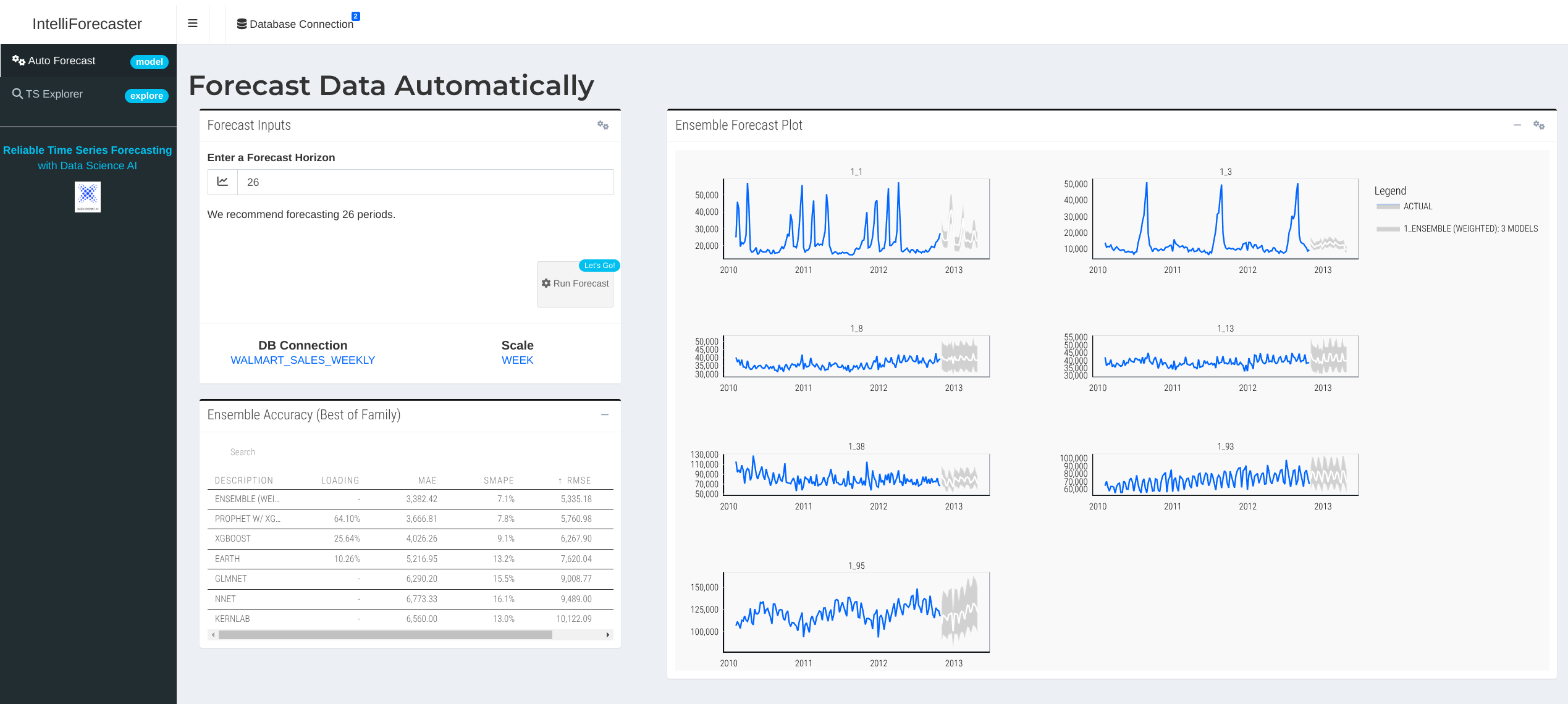
Intelligent forecasting system that automatically predicts future business trends with unprecedented accuracy. Instead of relying on guesswork or outdated spreadsheet models, the platform learns from your historical data to forecast sales, demand, inventory needs, and operational requirements. The system continuously improves its predictions as new data becomes available, helping any business make smarter decisions about the future.
ROI
Worked at the scale of a manufacturer with a $10M annual inventory and operations budget. Every figure comes from the inputs — swap them for yours and the outputs follow. How we build these numbers →
Inputs — what we assume about the business
| Assumption | Value |
|---|---|
| Annual inventory and operations budget | $10M |
| Revenue lost to stockouts during demand spikes | $1.5M/year |
| Excess inventory carried through poor demand prediction | $800K/year |
| Emergency procurement and expedited shipping | $400K/year |
| Revenue missed through inadequate capacity planning | $600K/year |
| Manual forecasting and planning labour | $200K/year |
Outputs — what automated forecasting changes
| Lever | Improvement | Arithmetic | Impact |
|---|---|---|---|
| Stockouts | 60% of the loss avoided | 60% × $1.5M | $900K |
| Excess stock | down 30% | 30% × $800K | $240K |
| Emergency procurement | 40% fewer expedited orders | 40% × $400K | $160K |
| Capacity planning | 20% better resource allocation | 20% × $600K | $120K |
| Manual forecasting labour | down 75% | 75% × $200K | $150K |
| Total annual impact | $1.57M |
Applicable across retail, manufacturing, healthcare, hospitality and logistics.
Benefits
- Adaptive Intelligence: Advanced machine learning automatically adjusts forecasting models based on changing business patterns, ensuring sustained accuracy during market volatility and seasonal fluctuations without manual intervention.
- Multi-Domain Forecasting: Single platform handles diverse forecasting needs from inventory and sales to staffing and maintenance schedules, providing unified visibility across all business-critical predictions.
- Real-Time Responsiveness: Continuous model updating and anomaly detection enable immediate response to market changes, competitive actions, and unexpected events that traditional methods miss entirely.
- Resource Optimization: Intelligent capacity planning and inventory management recommendations maximize operational efficiency while minimizing waste, freeing up capital for strategic investments.
- Risk Mitigation: Advanced anomaly detection identifies potential disruptions, fraudulent activities, and equipment failures before they impact operations, protecting both revenue and reputation.
- Strategic Planning: Long-term trend analysis and scenario modeling support executive decision-making for market expansion, product launches, and capital allocation with data-driven confidence.
- Universal Application: Works for any business that needs to predict the future - from small retailers forecasting holiday sales to large manufacturers planning production schedules.